

What Happens When an Accident Occurs with an Uninsured Truck Driver?
According to the Insurance Research Council, roughly one in eight drivers on American roads has no insurance at all. When that uninsured driver operates an 80,000-pound commercial truck, the consequences of a collision become far more severe, and the path to compensation far more complicated.
An accident with an uninsured truck driver leaves victims dealing with mounting medical bills, lost wages, and property damage with no obvious source of payment and a lot of anxiety.
If an uninsured driver injured you or a family member, you likely have more options than you realize. An experienced truck accident lawyer understands how to uncover hidden sources of recovery and hold negligent parties accountable, even when the at-fault driver carries no policy.
What You Need to Know About Uninsured Truck Driver Accidents
- Federal law requires most commercial trucks to carry between $750,000 and $5 million in liability insurance, so an uninsured trucker may indicate broader regulatory violations worth investigating.
- Your own uninsured/underinsured motorist (UM/UIM) coverage may pay for medical bills, lost income, and pain and suffering when the at-fault driver lacks adequate insurance.
- The trucking company that employed or contracted with the driver often bears liability for the crash, regardless of the driver’s personal insurance status.
- Third parties such as cargo loaders, maintenance providers, and truck manufacturers may share responsibility depending on what caused the collision.
- A thorough investigation into the driver’s employment relationship and the truck’s ownership can reveal compensation sources that aren’t immediately obvious.
Why Would a Commercial Truck Driver Be Uninsured?
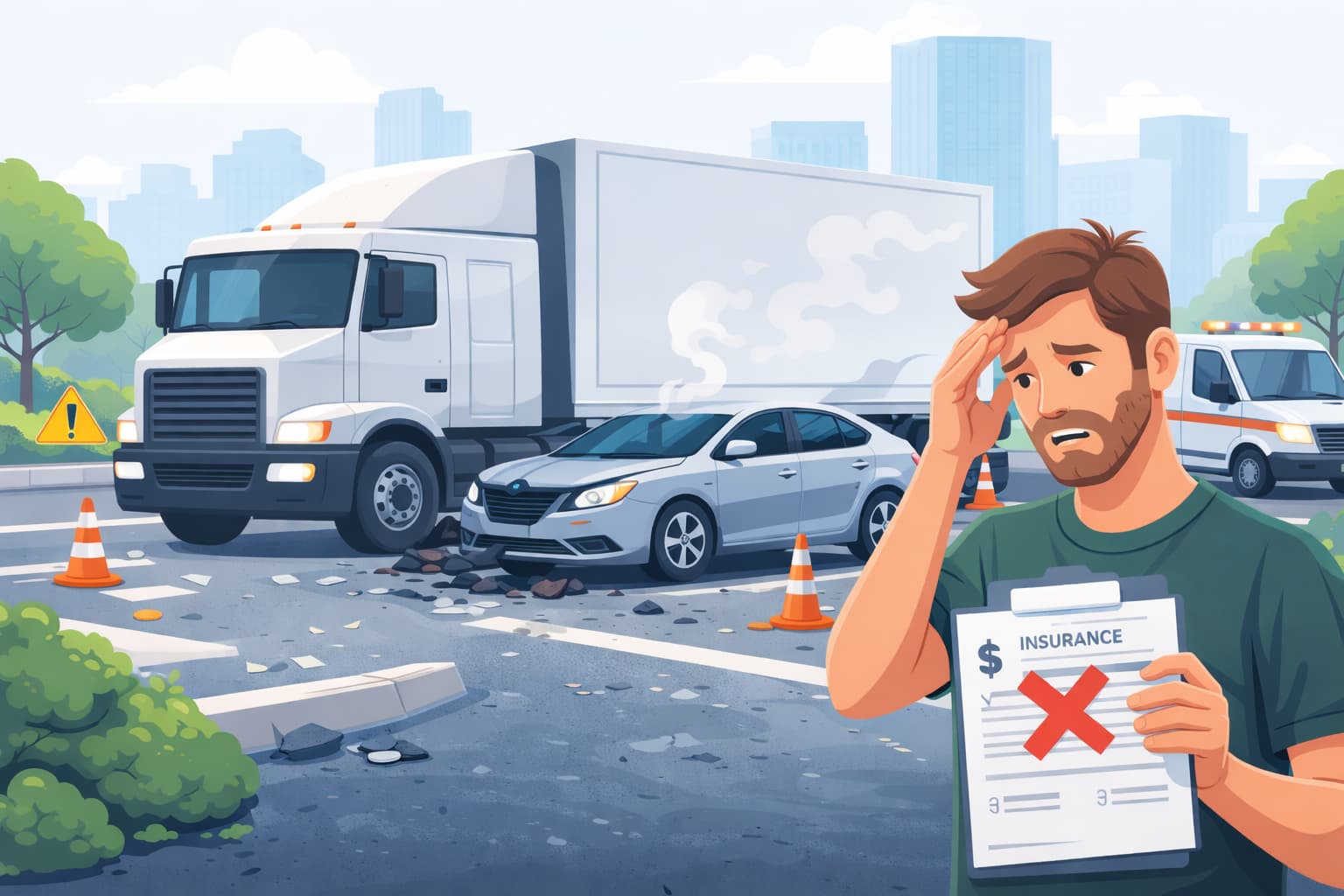
It seems almost unbelievable that a semi-truck would operate without insurance. Federal Motor Carrier Safety Administration (FMCSA) regulations mandate substantial coverage for interstate commercial vehicles. Trucks hauling general freight must carry at least $750,000 in liability coverage, while those transporting hazardous materials need up to $5 million.
Yet gaps in coverage happen more often than most people expect.
Some trucking companies cut corners to reduce operating costs, allowing policies to lapse or purchasing inadequate coverage. Independent owner-operators sometimes struggle to afford premiums that can exceed $15,000 annually. In other cases, a policy may have been canceled due to safety violations or claims history without the driver’s knowledge.
The situation becomes even murkier with leased equipment arrangements. A driver may assume the trucking company’s insurance covers them, while the company believes the driver carries their own policy. These coverage disputes often surface only after a serious crash occurs.
Unlicensed and illegal trucking operations
Some uninsured trucks belong to unlicensed carriers operating outside the law entirely. These “chameleon carriers” may be companies that were previously shut down for safety violations but reopened under new names to avoid their history. The FMCSA has identified this as an ongoing enforcement challenge, particularly in regions with high freight demand.
Lapsed or canceled policies
Insurance companies may cancel a trucker’s policy mid-term for non-payment or after an excessive number of claims. If the driver or company fails to secure replacement coverage immediately, they operate uninsured until they do. Unfortunately, victims of crashes during these coverage gaps bear the consequences.
Disputes over coverage scope
Even when a policy exists, the insurance company may deny coverage by arguing the driver was acting outside the scope of their duties or that the specific truck wasn’t covered under the policy. These disputes require careful legal analysis to resolve, especially when insurance bad faith may be a factor.
Where to Pursue Compensation When the Truck Driver Has No Insurance
Discovering that the trucker who hit you has no insurance feels like a door slamming shut. In reality, several other doors may still be open. The key is knowing where to look and how to build a claim against all the liable parties.
Your own UM/UIM coverage
Uninsured motorist (UM) and underinsured motorist (UIM) coverage exists precisely for situations like this. If you carry UM/UIM on your auto policy, it steps in when the at-fault driver lacks sufficient coverage to pay for your losses.
UM/UIM policies typically cover medical expenses and rehabilitation costs, lost wages during recovery, pain and suffering, and permanent disability or disfigurement. Colorado law does not require drivers to carry UM/UIM coverage, but insurance companies must offer it. If you declined this coverage in the past, now may be a good time to reconsider for future protection.
The trucking company’s liability
Federal regulations and common law principles often make trucking companies responsible for crashes caused by their drivers. Under a legal doctrine called “respondeat superior,” employers bear liability for employees’ negligent actions performed within the scope of employment.
This means the trucking company’s insurance may cover your damages even if the individual driver was uninsured. The company may also face direct liability for its own negligence in hiring, training, supervising, or retaining the driver. Trucking companies that put unqualified truck drivers behind the wheel may be held accountable when those drivers cause crashes.
Trucking companies operating in Colorado’s challenging environment—with mountain passes like the Eisenhower Tunnel and winter conditions on I-70—have a heightened duty to ensure their drivers can handle these environments safely. Anyone who has navigated mountain driving in Colorado understands the skill required; commercial truck operators face even greater challenges on these routes.
Third-party defendants
Truck accidents often involve multiple contributing factors beyond driver error.
Potentially liable third parties include:
- Cargo loading companies whose improper loading caused the truck to become unstable
- Maintenance providers who failed to repair known mechanical defects
- Truck or parts manufacturers whose defective products contributed to the crash
- Brokers or shippers who pressured unrealistic delivery schedules
Identifying these parties requires a thorough investigation, including review of the truck’s maintenance records, electronic logging device (ELD) data, and the contractual relationships between the various companies involved.
Filing a lawsuit against the truck driver personally
You retain the right to sue the uninsured driver directly for your damages. The challenge lies in collecting any judgment you obtain. Many uninsured drivers lack significant assets, making recovery difficult even with a favorable verdict.
However, this option shouldn’t be dismissed entirely. Some drivers do have assets that could satisfy a judgment.
How Comparative Fault Affects Your Truck Accident Claim
Many accident victims worry that any mistake they made behind the wheel will destroy their case. While contributory negligence matters, it rarely eliminates your right to compensation entirely.
Most states, including Colorado, follow a modified comparative fault system. Under Colorado Revised Statutes § 13-21-111, you may still recover damages as long as your share of responsibility doesn’t exceed 49%. Your compensation decreases by your percentage of fault, but you don’t lose everything.
Insurance companies and defense attorneys often try to shift blame onto injured victims to reduce what they owe. They may claim you were speeding, following too closely, or failed to react quickly enough.
A skilled attorney knows how to counter these tactics by gathering evidence that accurately establishes what happened. Accident reconstruction experts, witness testimony, and electronic data from both vehicles can paint a clear picture of fault that protects the value of your claim.
Steps to Protect Your Claim After the Accident

The actions you take in the days following a truck collision significantly impact your ability to recover fair compensation. Protecting your health and your legal rights requires attention to several priorities.
- Seek medical attention promptly. Some injuries from truck accidents don’t produce immediate symptoms. Traumatic brain injuries, internal bleeding, soft tissue damage, and even some spinal injuries may take hours or days to become apparent. Getting evaluated by a medical professional creates documentation linking your injuries to the crash and ensures problems don’t go undiagnosed.
- Hire a truck accident attorney. An experienced truck accident lawyer can investigate the crash, identify all potentially liable parties, preserve critical evidence, and handle communications with insurance companies on your behalf. This is especially important in uninsured truck driver cases, where finding sources of compensation requires a thorough investigation.
- Keep all medical appointments and follow your treatment plan. Insurance companies look for gaps in treatment to argue your injuries aren’t serious. Attending every appointment and following your doctor’s recommendations strengthens your claim and supports your recovery.
- Document your experience through a journal or video diary. Record your pain levels, physical limitations, emotional struggles, and how your injuries affect daily life. These personal accounts help demonstrate the full impact of your injuries in ways medical records alone cannot capture.
- Save all records related to your losses. Keep medical bills, pharmacy receipts, and documentation of missed workdays and lost income. Organized records substantiate your damages when negotiating a settlement or presenting your case.
- Avoid giving recorded statements to the trucking company’s insurer. You have no obligation to provide one, and adjusters are trained to ask questions designed to reduce the company’s payout. Let your attorney handle these communications.
Taking these steps early gives your attorney the strongest possible foundation to pursue fair compensation, even when the truck driver lacks insurance.
The Importance of Investigating the Trucking Company
When an uninsured driver causes a crash, the trucking company’s practices deserve scrutiny. Their negligence in hiring, supervision, or compliance may have contributed directly to your injuries.
Negligent hiring and retention
Trucking companies must verify that drivers hold valid commercial driver’s licenses (CDLs) and review their safety records before putting them on the road. A company that hires a driver with a history of accidents, DUI convictions, or hours-of-service violations may be liable for negligent hiring.
Similarly, companies that ignore warning signs about a driver’s unsafe behavior, such as near-miss incidents, complaints from other motorists, or failed drug tests, may face liability for negligent retention.
Hours-of-service violations
FMCSA regulations limit how long truck drivers may operate without rest. These rules exist because fatigued driving causes thousands of crashes annually. Drivers generally may not exceed 11 hours of driving within a 14-hour window after 10 consecutive hours off duty.
ELD data reveals whether the driver exceeded these limits before your crash. Violations suggest the trucking company failed to monitor compliance or pressured drivers to meet unrealistic schedules.
Maintenance and inspection failures
Commercial trucks require regular inspection and maintenance to operate safely. Brake failures, tire blowouts, and steering malfunctions can cause catastrophic accidents, particularly on Colorado’s most treacherous roads and steep grades, such as those along I-70 through the Rockies, the Million Dollar Highway, or US-6 over Loveland Pass.
Maintenance logs, inspection reports, and repair records may reveal that the trucking company knew about mechanical problems and failed to address them.
FAQs for Accidents with Uninsured Truck Drivers
What is the deadline for filing a truck accident lawsuit?
+
Statutes of limitations vary by state. In Colorado, motor vehicle accident claims must be filed within three years of the date of the crash under C.R.S. § 13-80-101. Missing this deadline typically bars you from recovering compensation, so consulting an attorney promptly helps protect your rights.
Does the trucking company’s insurance apply if they claim the driver was an independent contractor?
+
Trucking companies often argue they aren’t responsible because a driver was labeled an independent contractor. Courts look beyond labels to factors like who controlled schedules, routes, and equipment. In many cases, trucking companies can still be held liable despite contractor classifications.
What if my UM/UIM coverage isn’t enough to cover my damages?
+
When your losses exceed your UM/UIM limits, pursuing claims against the trucking company and other liable third parties becomes critical. Multiple sources of compensation may exist, and an attorney can help identify every available path to recovery.
How long do truck accident claims take to resolve?
+
Every case is different. Timelines depend on injury severity, liability disputes, and how willing insurers are to negotiate fairly. Your attorney’s priority is resolving the case efficiently while refusing to settle for less than your claim is worth.
What if I didn’t have UM/UIM coverage at the time of my accident?
+
You may still have options through claims against the trucking company, vehicle owner, or other responsible parties. A thorough investigation can uncover alternative sources of compensation even if your own policy doesn’t apply.
Getting the Help You Need After a Devastating Crash
Were you injured in a Colorado accident? Fuicelli & Lee offers free consultations — call (303) 444-4444 or contact us online.